
WordPress remains one of the most widely used website platforms, but in 2026, expectations around performance, accessibility, and clarity are higher than ever. Many business websites still fail to deliver real value—not because of the platform, but because of how the website is planned, built, and maintained.
In most cases, the problem is not WordPress itself. The problem is decisions made early in the project and a lack of long-term responsibility.
This article explains why many WordPress websites fail in 2026—and what businesses can do to avoid the most common mistakes.
Treating the Website as a One-Time Project
Despite changing market conditions and user expectations, many companies still treat their website as something that is “finished” after launch.
In 2026, a business website must support:
- Ongoing content updates
- Changing services and offerings
- New compliance and accessibility requirements
When a WordPress site is built without long-term planning, it quickly becomes outdated or difficult to adjust.
How to avoid this:
- Plan for growth and updates from the start.
- Choose a flexible structure.
- Treat the website as a long-term business resource.
Choosing Design Over Function
Design trends change quickly. What looked modern a few years ago may now feel heavy or unclear.
In 2026, usability, readability, and accessibility matter more than visual effects. Websites that prioritise animations or complex layouts often struggle to communicate clearly.
For businesses, the website’s role remains simple:
- Explain what the company does.
- Build trust.
- Support decision-making.
How to avoid this:
- Focus on clarity rather than trends.
- Design around real user needs.
- Keep navigation and content structure simple.

Ignoring Performance and Speed Expectations
User tolerance for slow websites continues to decline. In 2026, performance is no longer optional—it directly affects visibility and credibility.
Performance issues are often caused by:
- Heavy themes
- Too many plugins
- Poor hosting choices
How to avoid this:
- Build with performance in mind from the beginning.
- Keep the technical setup lean.
- Optimise images, layout, and loading behaviour.
Relying on Plugins Instead of a Solid Foundation
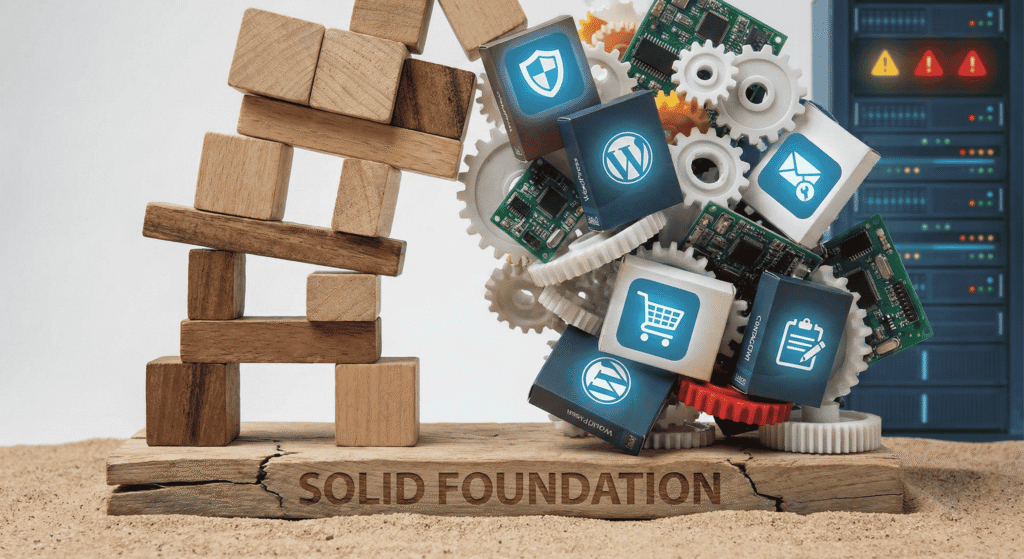
WordPress plugins remain useful, but overreliance on plugins is a growing problem.
In 2026, many failed WordPress sites suffer from:
- Plugin conflicts
- Maintenance complexity
- Security risks
Plugins should support a solid structure—not replace it.
How to avoid this:
- Start with a well-structured foundation.
- Use plugins selectively.
- Prioritise long-term stability over quick fixes.
Weak Content Structure for Modern Search and Users
Search engines and users now expect content that is structured, clear, and purposeful.
Common issues include:
- Generic service pages
- Poor heading hierarchy
- Content written without a clear intent
In 2026, content structure affects both search visibility and user trust.
How to avoid this:
- Organise content around real business questions.
- Use headings consistently.
- Make key information easy to find.
Lack of Maintenance and Ownership
Security updates, backups, and monitoring are still often neglected after launch. In today’s environment, website instability is not just a technical issue—it is a business risk.
How to avoid this:
- Assign clear responsibility for maintenance.
- Keep WordPress and components updated.
- Monitor performance and security continuously.
Final Thoughts
In 2026, successful WordPress websites are built with clarity, structure, and long-term responsibility. Most failures happen not because of the platform, but because the website is treated as a static product instead of a living business resource.
Businesses that plan properly, invest in quality foundations, and maintain their WordPress websites consistently are far more likely to see lasting value.
At Techspace, we approach WordPress as a long-term business platform—designed to stay relevant, stable, and useful well beyond launch.